

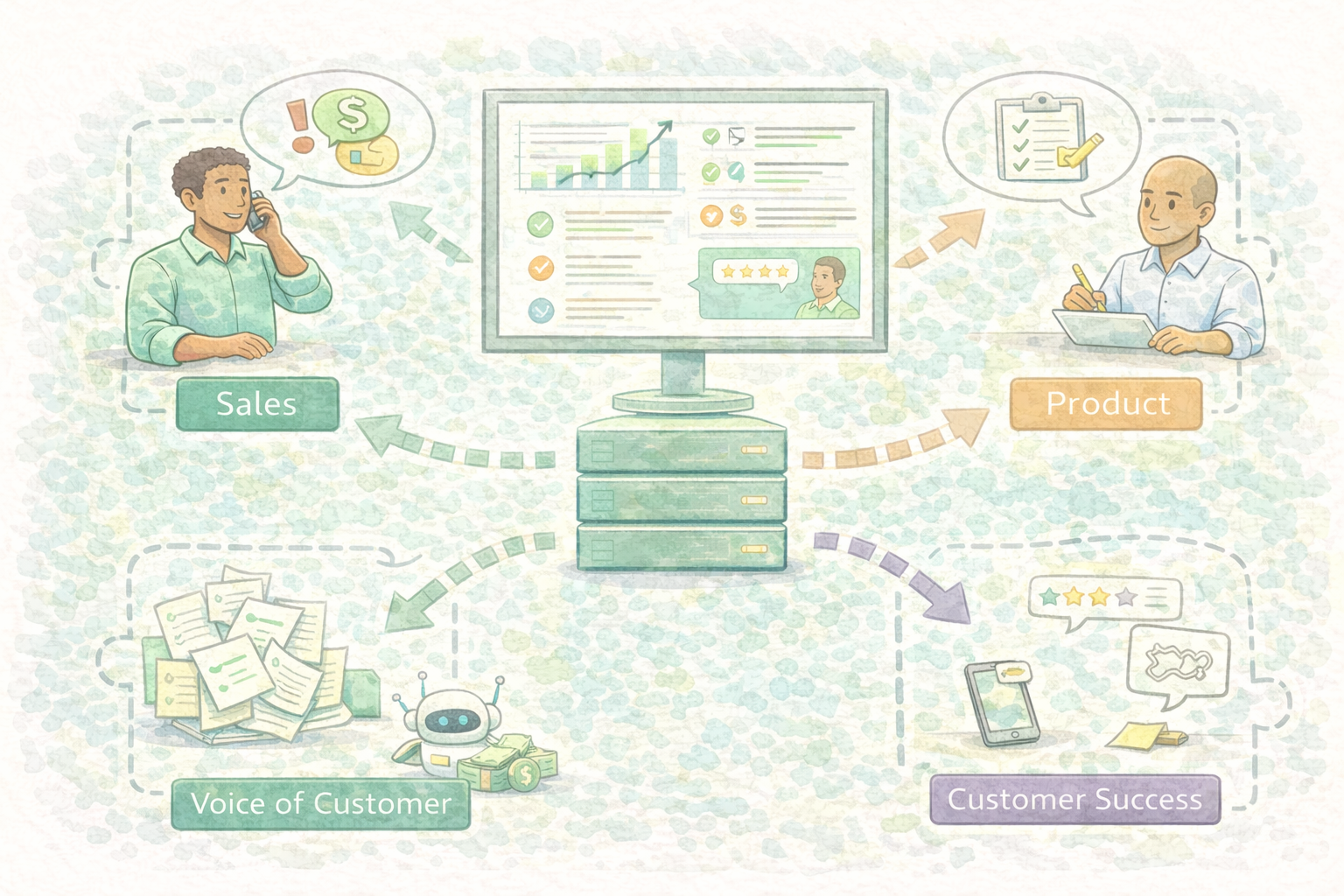
As SaaS companies grow, so does the volume of customer conversations.
But growth also brings complexity. Different teams collect feedback in different ways. Insights get buried in tools, tickets, and transcripts. And over time, the signal gets lost.
That is why scaling customer feedback is not about collecting more data. It is about creating structure.
The Risk of Scaling Without Architecture
Without a clear feedback architecture, companies start to drift from their customers. They stop hearing what really matters.
They lose the insight that drives better products, smarter strategy, and stronger relationships.
For GTM teams, this often shows up as churn signals that go unnoticed, missed upsell opportunities, and product investments that do not reflect customer reality.
What Strong Feedback Architecture Looks Like
The solution is not just to gather more input, it is to build the infrastructure that makes feedback usable.
A scalable architecture:
- Captures conversations across channels, not just surveys
- Centralizes insights so teams work from the same data
- Analyzes themes at scale to spot patterns early
- Ties feedback to action, not just reports
- Makes the customer voice visible at the executive level
This type of system creates the foundation for customer intelligence AI.
It transforms raw inputs into account-level knowledge that sales, product, and customer success teams can act on immediately.
The Business Impact of Customer Intelligence
According to BackEngine's Customer Feedback Maturity Report, companies with advanced feedback systems are significantly more likely to report improved product success, higher upsell rates, and stronger customer satisfaction.
For revenue leaders, this is the difference between AI adoption that stays theoretical and AI with customer context that drives measurable growth.
When feedback becomes part of the company's operating rhythm, Customer Success stops being reactive and starts driving expansion.
Sales gains earlier visibility into deal risks. Product decisions get tied directly to customer needs.
In other words, architecture is what turns customer noise into customer insight.
Next Steps for GTM Leaders
If you are serious about scaling AI across sales teams, start with the structure that makes customer feedback usable.
That is what turns scattered conversations into systematic intelligence.